Showing posts with label Film. Show all posts

Friday, September 21, 2012

Shopping the Film Stash #7 - Super High Me

Finally got around to watching Super High Me recently.  The concept for the film derived from a joke delivered on stage by comedian Doug Benson, filmmaker Michael Blieden's interests were piqued and thus the toke-reef-ic (I apologise, now that it is out of my system, it will not happen again, I swear) documentary was born.

Doug quipped that "...if there's a movie called Super-Size Me, why couldn't there be one called Super High Me, where I smoke pot every day?".


We follow Doug as he continues his stand-up comedy alongside two 30-day experimental cycles.  The first sees him go teetotal in preparation for phase two, where he smokes and or ingests cannabis all throughout the day, maintaining a state of inebriation for the entire thirty days.

It ain't all fun and games and sitting around listening to his breathing and marveling at the ways of the universe though, Benson is a self-professed seasoned smoker, and functions well in maintaining a productivity level befit to someone involved in making a film.

Thus we journey with Benson to some of the Los Angeles drug-dispensaries.  The proprietors detail the products they sell outside of the regular green.  They are in fact tending to medical needs, some of whom are suffering because of smoking-related troubles.  The idea of the lip-balm blew my mind.  Check it out.

What the film lacks in resolution it makes up for with its protagonist, if you can call Benson such, it being a documentary I am unsure.... our hero?  Benson guides us through the wayward path nicely, neither becoming preachy or defensive for the 420 past time.

Containing cameos from a slew of brilliant American comics, if all the wordy-ness and mind-boggling facts gets too much for the indulgers out there, you can enjoy the various snippets of comedy gigs where Benson and co preform.  The movie also features the legendary UCB comedy theater in LA, as well as footage from some of Benson's infamous "The Benson Interruption" shows.  (He literally interrupts another comic's set with querys, comments, and stoner confusion.)

The concept is hilarious, the outcome is curious, and the journey is equally hilarious and curious.


Shopping the Film Stash #6 - American Graffiti


Nostalgia is a glorious thing, for it allows you to rose tint the past and blur the memories of the not-so-fond times. Sometimes, however, nostalgia is utilised to expose flaws of both the past and the present.  This is my personal assessment of nostalgia concluded from the research I conducted during the course of my thesis.  My subject was Mad Men and American identity, so nostalgia was one of the first port of calls in theoretical aspects.  My journey through academia brought me to Frederic Jameson's essay, Postmodernism, or The Cultural Logic of Late Capitalism, analysing the state of pastiche in film.

His main argument centered on the unoriginality and lack of depth that any postmodern text remotely nostalgic or indicative of pastiche.  He lambasts postmodernism and its attachment to commercialism, signifying how it favours commodity, indulges nostalgia, and ultimately negates critical value.

American  Graffiti is mentioned in his hit list of films that is guilty of submitting to pastiche and la mode retro (nostalgia mode).  On the offset, it contains all the symptoms of what Jameson's describing; we've got a period piece, 1962, perfect for the selective retrospective eyes; a coming of age tale; one night in the lives of Californian youth before summer ends and another school year begins; a ensemble cast, every niche and stereotype is ripe for the taking.  Jameson argues that this this template enables an ideology to be created.

Claiming the nostalgia mode to be a colonization of the past is redundant to the artifice of the film.  It's utilization of the historical past is hardly the kind that pillages an era of its own authenticity.  Yes, American Graffiti sets out to capture the mood of a certain era, that burgeoning transition between 50s American commercialism and the 60s revolution to be precise (ha, could that BE any more vague?), but it does not get lost in preoccupying itself with the recreation of the diners, the automobiles, the fashion, the haircuts, the lingo.

Perhaps it is because it was made merely a decade after it was set, but George Lucas's film feels raw and natural.  The cinematography isn't over stylised, so much so that it feels documentary unlike the romanticism that Jameson suggests.

The premise lends itself to pastiche, with the action taking place on one of the last nights of the summer, two soon-to-be college students, Richard Dreyfuss and Ron Howard as Curt and Steve, decide to have one last night out in their one horse town.  It is a transitory time in their lives, much like 1962 was a transitory time for America.

Along with a couple of more friends and memorable characters, (along with a particularly memorable cameo from a post-carpentry, pre-Star Wars, Harrison Ford), an unforgettable night ensues.  The original, modern-day coming of age high-schooler movie?

Sure the backdrops are familiar; the girls and boys toilets, the chats in front of the mirror; the drive-in movie; the local hang-out is a diner where the waitresses are on roller skates; the arcade; and there is even an open road notorious for drag racing, where a climatic scene takes place. 

Template settings aside, the teenagers feel like teenagers, a rarity in a film with teenagers.  There isn't a bulging jock, twerpy nerd, nor asinine cheerleader for miles around.  These are normal youth in flux, without the inexplicably wordy, introspective gobshites around to kill the moment.  Interestingly, Lucas is said to have vetoed the first version of the script because he felt like, "It was overtly sexual and very fantasy-like, with playing chicken and things that kids didn't really do, I wanted something that was more like the way I grew up."  

American Graffiti is more like a snap shot, a long lost postcard rather than a pastiche that threatens to obliterate our true relationship with the past.  This is not an attempt to be a sermon on our history, or even a rewrite of history, this is simply a moment in time, with ordinary people.  Bar an end-credit revelation of what became of the characters, there is no omnipresent wink, no case of dramatic irony setting the tone of film.  It is an homage to an era, and a dedication to lost youth and rebellion, taping into the spirit of early rock and roll culture of America.  

You are following these teens around on a night where nothing really major happens, because that is you.  Haven't we all wandered around aimlessly with friends, because we have all at the awkward age where staying home with the parents is boring, but there really is no place for you to go and be civilised.  You didn't belong anywhere and neither do these guys.  There is no motive about Kennedy, Vietnam, or the Civil Rights amendments (you know, the juicy stuff film usually sinks its teeth into in the 60s), this is pure unadulterated nothingness and that is what makes it fun and familiar.  However, as mentioned previously, there are some coming of age moments abound, but not in the epic, monumental, uncouth manner of today - it is more like Curt and Steve come to some realisations and then act upon them accordingly. 

Lucas has given youth a voice and depth of character that feels unaffected.  The nostalgia emerges not from the construction of the film, but from where we relate to the people and their happenings.  

Wednesday, June 13, 2012

Shopping the Film Stash #4 - Dogville


*Whoops forgot to publish this*


I can't imagine how difficult it was to review Dogville as a film journalist.  I personally could never have reviewed it objectively because of the emotional journey and visceral toll this brought me.  But luckily this is a personal blog so I will not have to worry about that until I am being paid.  Any day now....

Dogville tells the story of a young woman Grace, Nicole Kidman, who, seeking sanctuary from a gangster, stumbles into a tiny, isolated village and thus comes under the mercy of its mysterious inhabitants.

At first, though the village elders are reluctant to take Grace in  and shelter her from her undefined threat, once she has been welcomed into the community, things seem altogether rosy.  Lars von Trier is the master of luring one in to a false sense of security (hark back to the lavish wedding festivities in Meloncholia, the seemingly innocent band of outsiders in The Idiots).

Little by little, deceit and foreboding treacle into proceedings.  As the vulnerable asylum seeker, the residents of Dogville begin to take advantage of Grace both mentally and physically.  They use their apparent kindness in taking her in as collateral to commit abhorrent acts.

Just when Grace, and the audience, think that they can rely on Tom (Paul Bettany) to uphold his knight in shining armour role, he too succumbs to the decaying morality of the Dogville locals.

Set

Aside from the relentless storyline, one of the most striking elements of the film is obviously the set design.  The sparse, stage-like open plan serves to reiterate the bleakness of Grace's position and the invisible walls emphasise the ignorance of Dogville folk.  She is helpless in the isolated and unforgiving terrain of Dogville.

Without spoiling anything, just a note of the closing credits, whereby the use of the David Bowie's "Young Americans" inspires a severe "a-ha" moment.  Von Trier's scathing criticism is as equally grim as this bastardised Gothic fairytale.

Dogville and its people represent the nature of human flaws and the misguidance of greed and selfishness that in the end cripple modern society.  The vocabulary of cruelty and manipulation are all too familiar, and the casualness with which they are wielded in Dogville provoke uncomfortable reassessments, particularly alongside the final, redemptive act of the film.

Sunday, May 13, 2012

Shopping the Film Stash #5 - I Could Never Be Your Woman


Let's just get one thing out of the way before I continue, a great disservice has been done to the world because Amy Heckerling's I Could Never Be Your Woman was never released in theaters.


Heckerling's film is an ode to the sorry state of 21st century feminism.  Michelle Pfeiffer plays the disillusioned heroine, Rosie Hanson, working as script writer and producer for a TV show that invariably encapsulates the garish influence of commercialism in society.  Her confidence and personal identity is already under threat due to her neurosis, but that further multiples with the onslaught of her daughter Izzie's adolescence and the unexpected presence of a younger lover, the goofy Adam (Paul Rudd).

Rosie is what has been missing from the canon of the romantic comedy, and what, invariably due to how poorly the film was clearly received, will continue to be absent from this canon.  She is an honest depiction of the modern woman, particularly that of the more mature, successful variety.  Sure she's sexy and has a thriving career, but she's also a divorcee, a mother, and a frustrated (read - pissed-off) feminist.  She is pissed at the male-female dynamic, and she's passing her wise philosophies onto her protege.  Saoirse Ronan has often played beyond her years, but this time it's nice to see her play her own age with abandon, if depicting one who is a little precocious.  She is well on her way to becoming a very independent and self-possessed lady.  She teaches us all a lesson worth noting.  See video below.  (These days this message may be more applicable to the likes of Katy Perry or Rihanna, amiright?)


The film is not perfect, the plot's a little thin, the subplots are way too Scooby Doo-ish, Paul Rudd is the anti-love interest, but not in a good way.  But there's something about the message I just find to be rather empowering, as I just don't see it enough in cinema, or in media for that matter, nowadays.  On an aside, the recent backlash targeted towards Girls is just pissing me off....  Which brings us to the best part of the film, Mother Nature.  Tracey Ullman brings life to Heckerling's sardonic pessimist and Rosie's personal conscience/wise-ass.  She's pretty much a personification of everything women, of the realistic and honest variety, would like to say, do, and eat.  She empowers Rosie with her honesty and witticism, but is also there to ground her and call her out for being ridiculous.

This bohemian, rational version of Mother Nature is the antithesis of the Mother Nature that predominates in culture.  Usually we are led to believe women are at the mercy to the whim of the all-ruling mistress of our bodies.  The cliches of the emotionally unstable crying lady, and the hormone-enraged bitch.  Mother Nature is blamed.  We are weak because of the apparent existence of this ruler and our subservience to her.  Women, Rosie in this instance, can in fact live harmoniously with her.  It's a democracy, not a dictatorship.  Rosie and her Mother Nature have a back and forth; a relationship rather than a negotiation.

Sorry for the rant, but this film just magnified for me how women are treated and portrayed.  I'm not exactly one to talk, one of my favourite genres is War film, where women are one of three things usually, the mother, the devoted partner, or a prostitute.  And I couldn't even name a list of fabulous female directors or writers that I respect and yearn to emulate.  If anything this movie has called me out on my own sexism.  My own ignorance is palpable in my preferred tastes.  Rosie struggles to sustain the love of what she does, not because of her own issues, but because there are people like me who are forcing her into to unfulfilling careers because it's convenient for us.

Guys, let's just try to be better to each other.  


Tuesday, February 21, 2012

Really need...

I really need  to stop catching up on so many TV shows and get back to movies...

but first more Spaced!


Thursday, February 9, 2012

The Descendants

Although it would be nice for the Academy to get over their George Clooney-love in, The Descendants trailer was undeniably appealing.  It looked invigorating, spiritual, a perfect anecdote to the gloomy shroud that consumes you during winter.

(Will not be held accountable to adverse affects experienced from lusting after Hawaiin climate...)

The film marks also the return of Alexander Payne, last heard from with Sideways.

The film opens with a brief shot of a woman on what appears to be a jet ski, what is compelling about this scene is her expression, one marked be utter contentment.  The fade to black is ominous.  We soon learn that that woman was Elizabeth King, now in a coma, a wife to successful and frugal lawyer Matt King, who is diligently working by her hospital bed in the establishing shot where he narratives a brief summary of life and up to there.


The coma acts as a catalyst which through Matt's otherwise comfortably uneventful life is thrown into disarray where he must acknowledge things and take action.  He is forced to commit to parenting for the first time in his life, referring to himself as the back-up parent.  His unruly seventeen year old Alexandra, played by the unexpectedly sublime Shailene Woodley, and petulant Scottie are independent forces to be reckoned with.

He learns his wife was cheating on him and planning to leave him.  While this sets things in motion for the journey of the film, the trailer makes it seem like this is what the film centers on.  Wrong.

Matt's entire journey seems to be summed up in the allegory of the land.  He is the named trustee to a large acreage of land, and he and his cousins are in the process of figuring out who to sell the land to.

Because the subplot of land, (woah careful now, I am making this sound like a sequel to The Field) Hawaii predictably becomes a character in and of itself in the film.  It clearly has a profound effect in rebuilding the relationship between Matt and his daughters, and helping them through their grief and anger experienced in the aftermath of their mother's accident.

This would be my only gripe about the film.  Its predictability.  It does not shy away from cliche or sentiment, which is probably a result of the source material, the novel by Kaui Hart Hemmings.  While it is far from a run of the mill chick flick, there is almost a paint-by-numbers characters progression but this has thankfully been peppered with enough Alexander Payne flair to rescue it and brings it to life.

It's a genuinely funny piece.  It combines many levels of humour without going overboard, we get a little bit of physical comedy, thanks to out of shape Matt's jog in flip flops down a spiraling Hawaiian suburban hill.  There's a little bit of stoner exploitation, courtesy of Sid, (Nick Krausse), Alexandra's inexplicably present boyfriend.  The caper quality, perhaps a nod to Clooney's Ocean Series, bestows the film with an adventurousness that involves the audience, giving a emotional connection.  You will root for this family as they scour the beaches in search of the adulterous mother's partner.  Also the Hawaiian uniform provides a good ole laugh, probably unintentional.


Clooney is obviously promoted as the face of the movie as he's a big box office draw, but the way each character is drawn in this story is genius.  Each character is given such dimension.  Even Brian Speer (Matthew Lillard), the man whom Matt's wife was in love with, is likable because his vulnerability is shown.  So even though the movie itself delves into cliche, the characterizations and actual performances strengthen any weaknesses.

Even though I was hyper aware of the cliche, blame my English course in film for making me so judgmental,  the film still manipulated an emotional response out of me.  Because what is shown in The Descendants is truth in many ways.  It does not dwell on the "why me"s, but simply shows these people dealing with everyday life even though their world has utterly changed.

Cliche is cliche for a reason, even though we think we are all individual, we all invariably go through similar experiences of pain, beauty, happiness, and grief.  The Descendants is actually a very refreshing take on that, not unearthing shattering, but thank Hawaii.  And Alexander Payne.


Wednesday, February 8, 2012

Shopping the Film Stash #3 - Frankenstein (1994)


So how grossed out were you when Frankenstein was covered in amniotic fluid?

Overall I think this film was unintentionally hilarious.

Good day!

Monday, February 6, 2012

The Ignored

While the Oscars, in the long run, do and should not affect the quality of a film, the awards show and a nomination sure as hell invigorates the life of the film and actors and manipulates the public's own perception of a film.

Let us take George Clooney for instance.  Who really took him seriously before he won for Syrianna and was nominated for Good Night, and Good Luck?  He was ER star who transitioned fairly seamlessly to film, but was primarily known for his roles as a playboy-esque, cheeky chappy.  He started working with the right people however, the Cohen Brothers, Steven Soderbergh... and has since possessed a glistening Academy Award sheen.  He can literally do no wrong, and even though as an actor he is flat and little bit of a one trick pony in terms of depth of character, he has for the last few years pretty much been a permanent fixture throughout awards season.

Sure he doesn't really deserve to be there, but is there, and is being acknowledged, like so many other "meh" performances.  Not that are really and truly meh, and not that I really have a problem with Clooney, but Awards season has become achingly predictable.  Every show basically has the same list of nominations.

(On a side note, who would have thought such a mediocre novel such as The Help would have inspired such a passionate response for its filmic version?  Either that or voters are afraid it would have been prejudice not to include it.)

While my distance from a cinema has sadly hindered my access to most of the nominated lot this year, there are a few glaring omissions that I would love to briefly discuss.


Melancholia
more in-depth review here


Maybe I am alone here, after all it received only average ratings, from the likes of Total Film and Empire, from what I can tell, but I felt Melancholia was the "revelation" moment of cinema in 2011.  In a society so bruised by economic strain, a possible impending apocalypse, and in a planet where depression is still discussed in hushed voices, Melancholia was unafraid to tackle the everyday strain of existence and expand it into a feature length masterpiece.

Lars von Trier has more than likely been permanently shunned by Hollywood after his bizarre Nazi comments in Cannes, but what a shame that the film and actors anchoring the project have been ignored also.

Kirsten Dunst and Charlotte Gainsbourg achieve something so very rare in film, they deliver muted suffering that speaks volumes more than hysteria.  There are intricacies of gesture, expression, and hesitation that is magnified by hand-held camera motion.

Performances such as these always impress me more than a portrayal of a real-life character. Not that Meryl Streep's performance as Margaret Thatcher wasn't amazing and powerful, it was.  But to bring to life a character so vividly from its foundations in the two-dimensional space of screenplay is something really worth speaking of.


Super 8


Yes it was a summer blockbuster.  Yes it was sentimental.  And YES it was a Spielberg pastiche if ever I saw one, but those are also the reasons I adored this film!  I can guarantee it will just bring you right back to when you were a kid, when you first started watching films, and were in awe of the very medium you were witnessing.  It is the Cinema Paradiso for the 21st century.  And yes, I am aware that was released merely twenty odd years ago....

The storyline was a little cliche, but a lot of films are cliched.  Super 8 just reawakened the soul!  I can barely describe this probably I just simply urge you to see this.  It gave children a voice beyond the wacky, cheeky, snide cartoonish renderings we have been seeing in the past decade and it was showed the parents and children can be vulnerable as well as brave.

It was the perfect anecdote to the summer/thesis blues.  I have not seen Hugo, so I guess I am being completely bias, but Hugo looks so extravagant, I am all for the blue collar underdog which is what you will find with JJ Abrahams pet project.  And Hugo was 3D. Eugh.

Where is the best original screenplay?  And WHERE is Elle Fanning's recognition?


The Guard

Maybe this movie didn't travel well.  It is extremely colloquial, and to weaker disposition, probably offensive.  Besides comedies rarely capture the Academy's attention as well as a good weepy.

But wait.  Melissa McCarthy, nominated.  Maybe there will be hope for Brendan!  Nooo.

Yeah I have a love hate relationship with Bridesmaids.  It was funny, sure.  I laughed, yes.  Those girls were funny, yes.  But I would not return to this film.  There's nothing there beyond a single viewing.  The only revolutionary thing about it is that is starred and was written by women.  Women writers have been around a long while and have been doing just fine for themselves.

The comedy was gross out comedy with girls.  Not terribly engaging, sorry to have to say.  It was funny in a kneejerk, slapstick kind of way but on repeated watch the lustre will fade.  McCarthy was brilliant because it was a unabashed physical and comedic performance, but it was like her antics was carrying the film.


Gleeson, on the other hand.

I know they say Ireland, the Irish, carries a beautiful duality of humour and melancholy and this is what Gerry encapsulates.  Just when you think he is one dimensional thuggish cop, you see him with his mother.  He is humanised.  He has woes, and faults, and he is real.

50/50

Yeah I've spoken about this before too so I promise I really won't bore you with this one, but let us just say it has been robbed everywhere by all accounts.  Bryce Dallas Howard for being a heartless bitch in the face of cancer.  Seth Rogen for being the obnoxious but lovable and caring friend.  Joseph Gordan Levitt, for enlivening a character who is suffering but who refuses to go down the route of caricature, where the bucket lists reside.  It is relatable, and endearing, and Angelica Huston remains a force to be reckoned with.

We Need to Talk About Kevin

Terrifying and challenging to watch. Yet refreshing to see a portrayal of a mother who find it hard to unearth the patience to rear or even love her son.  She's a woman tormented by unfulfilled aspirations, and barely hides the fact that she blames her son for her stilted life.  Then there is Kevin.  Damien incarnate.  Not so much evil as seeking his mother's love.  A film calling attention to the fact that we are all products of our environment.

Tilda Swinton and Ezra Miller have suffered a grave injustice.


------------------


I literally think my favourite thing about film in 2011 is when filmmakers and actors just went for a more pared down version of a film character, and situated you in a more realistic space and life.  Relatability is a very attractive thing in cinema.  Don't forget this Film of 2012.

Sunday, February 5, 2012

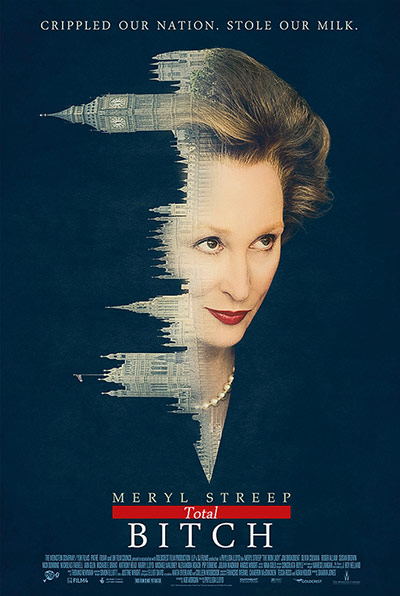
The Iron Bitch


Courtesy of The Guardian

Shopping the Film Stash #2 - Drive

Wikipedia, I know, not the most illustrious source, describes Nicolas Winding Refn's Drive as an arthouse action drama film.  I say it is more like the arthouse version of watching paint dry.

I was a latecomer to this film, which came out last September if I am not wrong.

It received huge plaudits at Cannes, and most critics fell over themselves with love for this, but at the time I had little acces/funds to see it in the cinema, so put it on the back burner.  I went retro the other day and rented it out at a local DVD shop.

Now it is not that I was disappointed with the movie, all the elements are there.  The cinematography is unbelievable, the performances are fantastic, bar may I saw the leads, the soundtrack is all kinds of amazing, the script is even decent, but combined it feels like it knows its good and it is the smug self-assurance that throws me off.

I just don't understand
Drive rested on its laurels as simply being a beautiful film. Even the smearing of violence lacked the capacity to be thought provoking.  Ryan Gosling's Kid, or Driver, was underdeveloped.  Though this mute hero has become something of a cult obsession now, some people like the way we are literally dropped randomly into his story, and he of all people gives no clue to who or why he is.  His motivation is undefined, thereby the romance between him and Irene seems completely implausible.

I am still undecided as to whether Gosling is overhyped in general or underused in this film....

Due to the lack of emotional depth, and therefore empathy, the characters are decidedly bland, and when characters are bland everything else is washed out and dull.

Albert Brooks, who got a lot of Awards buzz, but no cake, does light up the screen in a way.  It is fun to see him play against type as a thug.  He at least creates a ripple in another wise still ocean.

I am obviously missing something, but all I really took away from this was the killer soundtrack along with the honourable cinematic homages, (cheap pastiche?), to Taxi Driver and Bullit.

Driver will never be McQueen.

Shopping the Film Stash #1 - Heathers

As I now live two hours from a decent cinema that offers variety and limited release choices, I have been both gathering and diving into the DVD archives.  I have found myself creating a list as long as my harm, a bucket list of films to see, to study, to learn.  Directors, script-writers, and actors constantly site various source material when speaking of their craft, and throughout the last year while writing my thesis and pouring over various film reviews I have learnt that a film critic is no different.  The annals of film is a critic's bible when writing an objective review.

So to train my amateur writing hand a little better I am setting out on a little exercise and visiting some cult classics, films that have come to my attention over the last year but have so far been somehow neglected, and perhaps even some oldies that I love!

All in the hopes of extending my film vocabulary....


Heathers (1989)

I remember seeing Mean Girls in the cinema thinking it was refreshingly different from the other teen comedies that had been circulating around that era (the era I speak of is that Golden Age of Millenia-teen films, 10 Things I Hate About You, Down To You, She's All That, but to name a few, I guess Mean Girls was a few years after, but you get my drift).  Mean Girls came along and set about debunking the romantic notions of teenage-hood, and decided to shed some light on the harsh realities of High School.  There was less, I stress less, of a focus on the girl-likes-boy dilemma while the examination of the fickle foundations of female friendships really takes center stage.

Though Tina Fey's originality and wit are boundless, Mean Girls, its plot, and characters owe everything to Heathers.  Heathers is a far superior, satirical, more sinister commentary on the tenuous years of High School.  It villainises these characters, giving them unprecedented power, the exaggerated (but not altogether unimaginable) murder plot parodying the usual hormonal deviations of an American teen.

"I just killed my best friend"
"And your worst enemy"
"Same difference"

Well hello, shoulder pads...

Veronica, the oft under-appreciated Winona Ryder, is a girl who is not named Heather but who has been given divine access to the elite Heathers clique, for reasons unknown.  At first she feels privileged to be included and is even enthralled by the warped superiority of the malevolent lead Heather.  She is enamoured by Heather's philosophies, that in fact justify her tyrannical ways, "Dear Diary, Heather told me she teaches people real life."  The film is full of gems like this, Fey wishes she could be this raunchy and self-assured in her writing.  Heather 1 is like a cacophony  of teenage-hood and adulthood, she is self-possessed, relishing her youth yet outgrown the anxieties of her peers.  She is acutely aware of her surroundings, so much so that she has created her own glossary, according to her authority, "very" marks a seal of coveted approval, Heather desires very, because she desires excess and vitality.

She blithely critiques the stereotypes of youth, and condemns her followers for falling victim, "Grow up Heather, bulimia is so '87."  Still inevitably lacking sympathy, Heather's independence is what makes her both enviable and caustic.

She eventually tethers nerves, leading Veronica to naively succumbs to her new boyfriend's scheme to throttle the queen bitches, after unwittingly becoming an accessory in Jason's murder plot, when Heather 1 ingests her poisonous end.

Christian Slater plays Jason Dean, and though in Jack Nicholson's psychosis The Shining mode, when clothed in leather jacket and straddling a motorbike he personifies James Dean 2.0.  He is an 80s incarnation, the upper-class rebel without a cause who sets about invigorating a spirit into an era that lacked the rebellious attitude that drenched the Hippie 60s and 70s punks.

Slater, making evil acceptable in 1989.
Though murder and mayhem landmark her journey, Veronica is actually an admirable character, even somewhat a feminine role model.  She takes a stand, an intense one, against bullying.  And though they are the MTV generation's Bonnie and Clyde, when she realises that she has descended into psychotic territory with her boyfriend she transcends this too.  She evolves beyond the suburbia complex, the vacuous pandering of unmitigated angst.  Even this is tackled ironically, when after further rampage, Veronica consults her diary again, professing that "...my teen angst bullshit has a bodycount."

Veronica's rebellion from standards is where it is actually a reverse of Mean Girls.  Mean Girls begins with Cady and her friends devising a plan to conquer and destroy the influence of The Plastics.  Cady herself is blinded by power leading to a somewhat smaltzy ending where everyone learns their lesson and lives happily ever after.  Heathers' resolution, if it can be called that, is far more cathartic.  It abandons sentiment, a pitfall that much mainstream American cinema.  Both film's exhibit climatic scenes in a school gym, both are executed extremely differently.  Mean Girls looks like an after-school special in the shadow of Heathers' explosive metaphors.

The final word on Heathers.  How very. 

Monday, December 12, 2011

The Majesty of Melancholia


When the opening sequence of a film is reminiscent of a series of Surrealist painting you know you are set for both a aesthetically and intellectually challenging ride.


"I'm trudging through this grey wholly yarn.  It's clinging to my legs.  It's really heavy to drag along."


These days Lars von Trier is more infamous for his strange Nazi outburst at Cannes this past summer, which is a shame because that has overshadowed what he has achieved with Melancholia and will inevitably damage the film's chances at future award ceremonies, though it is one of the cinematic stand-outs of the year.

Both visually and thematically, von Trier re-imagines the genre of the apocolyptic film.  The all consuming nature of depression has been given the an allegory as a new planet dubbed Melancholia that is veering towards the earth, threatening existence.  Compared to previous work, von Trier describes Melancholia as the moment when a deer wanders in to listen to Jiminy Cricket at the end of a Disney Christmas special. It is just about as comforting as the cruel manner in which Disney films lure you into a false sense of security only to then reveal a horrible reality.  Melancholia deals with the horror of existence and fear of non-existence.

Part One focuses on the perspective of Justine (Kirsten Dunst) and sees her public facade crumble on the night of her wedding.  Those around her personify the underlined tension, which magnifies each time Justine disappears from the party.

We not only experience Justine's disintegration due to the overwhelming gravitas of the wedding reception organised by her sister Claire (Charlotte Gainsbourg) and her "filthy-rich" husband John (Kiefer Sutherland), but also the effect that Justine's illness and erratic manner have on the various members of her family.  Her guileless husband (Alexander Skarsgard), her oblivious father (the exquisite John Hurt), and a mother (Charlotte Rampling) who has no filter.

The film becomes disconcerting because at first Justine has a vivacious energy, then comes her mental descent, as the stifling ritual of the wedding etches away at her vulnerable psyche.  Though Claire sees Justine's behaviour as disrespectful, there is a sense that Justine is desperately trying to fight and repair herself before the evening is ruined.  When she goes AWOL to take a bath, this is a healing action, an effort to cleanse away what is perceived as mental impurities.

Melancholia will be appreciated because of its refusal to depict unnecessary hysterics to communicate Justine's experience.  The indeterminacy her mentality in contained in an authentic and relatable mode of communication.


Throughout Part One, though an underlying resentment does emerge between Justine and Claire, yet Claire still remains loyal to her sister through her suffering.  In Part Two this theme is extended, though in reverse perspective.

We witness Claire battles her own neuroses, and the threat of Melancholia's ever-nearing presence reassigns the position of the sisters.  Justine is acquiescent and calm of impending events while Claire is frantic.  Call it her maternal instinct in wishing to protect her son, but Claire is unable to accept the forthcoming doom.  Her pragmatism unravels in the face of looming threat.

Dunst and Gainsbourg achieve a great symbiosis on screen.  They flesh out these sisters, their relationship and history, meanwhile never detracting focus from one another.  


Those familiar with Trier's older work, and Dogme '95 will see glints of the original guidelines within Melancholia's makeup. The manifesto included rules that emphasis the use of handheld camera, the work to be filmed in colour, and no superficial action (aka murder).  While the aforementioned aspects are noticeable here, von Trier has largely abandoned the restricting methods of Dogme.  

 The most impressive element of Melancholia is that it is able to maintain engaging momentum throughout its meditative exposition.  As surreal and disjointed as proceedings are, the emotion is relatable as it never veers in to the overblown territory that Hollywood would have taken it. 


Friday, December 2, 2011

Femme Power #1 - The Huston Collection

It feels like our society is depriving women of strong females to whom we can aspire to.  When I say this I am obviously negating the likes of Lady Gaga, Madonna, and the like.  This is not to take away from their achievement or creative genius, nor to discredit the empires which they have built.  I aim more to comment on the fact that it is gimmick and ostentatious flare that has catapulted these into the annals of our history.  Justified, but for the right reasons?

Because I endeavour writing on film to be my ultimate forte, I think it would be fun to begin a series that looks at specific women on film, or in the film industry, whom I admire, along with a selection of their projects, and the reasons for such choices.

What with it recently being October, breast cancer awareness month, and my own life has spiraled into a period of reflection in my postgraduate state of limbo, I feel it is important that as I enter in the abyss of adulthood that I celebrate my fellow females, and recognise their humility, hilarity, empathy, strength, and fearlessness.


And so the Femme Power series begins with - Anjelica Huston.

To begin, I must introduce this legend.  She was the Hollywood seductress with a humanitarian heart before Angelina Jolie was of age.  She tamed Jack Nicholson intermittently over a sixteen year period.  She is Wes Anderson's on-screen mother of choice.   She has never been afraid to play the dominant female.  She never gave in to commodity pressure to be a rom-com Queen.  In saying that she has also, in her older age, not been afraid to participate in cinematic flavours of a lighter fare, and she owns the screen in doing so (she rocked those six-inch heels while working as a lollipop lady in Daddy Day Care.)

The site Nowness published an editiorial on Huston last year, and proposed that looking through her life and work is a study in elegance.  This is what Huston contributes to each character she inhabits.  It is not an elegance that manifests through the procurement of luxury, but rather the complete self-possession and sheer confidence she commands.  On top of all that it remains neither intimidating or off-putting.

50/50 served to reawaken me to what a complete powerhouse this woman is.

The following offers a snippet of evidence of why the world needs Huston.


This is Spinal Tap
As Polly Deutsch 

She cameos in one of the greatest comedies of all time.  This was the mockumentary that launched a thousand like it.  This is the mid-eighties and when you think back to the era now, 80s film history is weighted by the Brat Pack, Spielberg, and James Cameron's fledgling steps into cinema.  Christopher Guest's social satire broke the mold paved the way for a more wry, calculative comedy and Huston's brief role is not to be overlooked.  Ever minor role in film such is this is the sum of its part, and turns this bitch up to 11.  Huston chose wisely when signing onto Tap, after all who else could have handled the portrayal of an irate designer commissioned to craft a scale, replica Stonehenge.  She got her order from a napkin blueprint and she was not going to concede to Nigel's flakiness.  Being part of an independent project such as this obviously reinforced her indie-cred, a superficial observation, but true.  An early role for Huston, it ultimately provides a glimpse to the comedic versatility that she will demonstrate throughout her career. 


The Addams Family
As Morticia Addams

"They're creepy and they're kooky, mysterious and kooky..."
Not only do this lyrics describe the Addams Family collectively, but they encompass the entrancing beauty of Morticia, and the actress who brought her life on the big screen.  Here I emphasis the life.  Huston refused to simply hone a caricature of, well, the character.  With Huston at the helm, you don't focus on the macabre elements.  Morticia becomes first and foremost a mother.  She's protective of her little angels, to a certain extent, by protecting their integrity as individuals and their creative aspirations.  
Found this quote of perfection within the article at this link where Huston discusses Morticia
Whimsy, thy name Anjelica:
"She's optimistic, and she's a wild dancer."
Calamia!


The Wes Anderson Series

The Royal Tenenbaums
As Etheline Tenenbaum


As the matriarch of an abundantly dysfunctional dynasty, Etheline is a beacon of comfort to her estranged husband and troubled children.  Etheline is the sole Tenenbaum to whom progression in appealing.  Royal and the children are burdened with past glories as well as being reluctant to let them go.  Huston begins her work with Anderson by continuing a trend of choosing strong female characters.  Etheline has a command of herself as well as others, and Huston bring the right balance of quietude, empathy, and maternal compassion to reflect a woman aging gracefully in the midst of familial chaos.

The Life Aquatic with Steve Zissou
As Eleanor Zissou


Eleanor is the muse to Steve Zissou's successful oceanographer, but as their relationship dissolves, his career wanes.  The central arc the film revolves around Anderson's own quirky interpretation of the revenge film, as Zissou seeks to avenge his fellow oceanographer who was killed by a mythical Jaguar shark.  Zissou's credibility is already suffering, and this vengeful expedition incites further pressure.  The true source of Zissou's lethargy is the estrangement he and Eleanor are experiencing.  Huston resembles a heroine suffering in the abyss of existential uncertainty.  She has command over Zissou, but reflects vulnerability in her uncertainty while caught in an uninitiated love triangle. So while Huston can seemlessly inhabit women of strength and fortitude, so too can she explore the darker, insecure vestiges of the human character.

The Darjeeling Limited
As Patricia


In this Anderson tale, the mother is curiously an absent figure.  It is with trepidation that her three sons, Francis, Peter, and Jack, meet her.  Even when profiling a mother who is essentially indifferent to her sons' lives and crises, Anderson illustrates a pragmatic and ambitious woman who emerges from her portrait fairly unscathed.  The woman of strong will has always been a source of intense scrutiny, in film we saw the femme fatale, while in literature these independent women often become catalysts of disaster, a la The Great Gatsby.  This is hinted here with Patricia too, as the tension and distance between her and her sons is palpable.  Huston pursuit of strong females brings her to a the onscreen territory of un-likability, where the non-maternal mother is the most taboo of all.  She carries it off with enviable aplomb. 


Agnes Browne 
The Eponymous Character


Huston's second foray into directing.  Here her source material located in the milieu of working class Dublin.
Brendan O'Carroll's narrative follows the misfortunes of an Irish mammy, left widowed with seven children and little money.  While it may not have been received well in America - unfortunately texts that are so class specific tend to not translate well when out of home ground - there was no fear of Huston Americana sensibilities whitewashing the authenticity of the impoverished 60s Dublin.  This may even be Huston homage to her own Irish youth, where she spent most of her childhood in Galway.  Be it a love story to Ireland who knows, but as director and star she controls proceedings with a steady hand, developing each character's, even the numerous children, personal dimensions, and evoking the survival instinct of Agnes.  She evades the  tragedy and instead focuses on the spirit and humility that has become hallmark of quintessential Irishness.


--------------------------------------------


Another reason why she's become a personal hero of mine, while viewing the WB Yeats Collection at the National Library last year, she spoke of her desire to make a film about the unconventional tale of Yeats and Maud Gonne's love story, one of unrequited love on Yeats's part.  I have literally had this idea in my head for years, but as I am not a filmmaker, nor have any plans to become one in the near future, I will depend on Huston to fulfill this venture, because let's face it, Yeats's genius was spurred on by the passion that nestled within him because of the effects of Gonne, what could be more romantic or compelling?  Hollywood, pay attention to Huston and get this done.


On the To-See List
Prizzi's Honor


Her father, John Huston, directed her to Academy Award glory in this black comedy about two assassins who fall in love.
Will review once I get my hands on a copy. 

Saturday, November 26, 2011

The Big C on the Big Screen

Saw 50/50 in a matinee screening (why did I fail throughout my college years to attend these precious five euro matinee screenings?) earlier this week.


This is the first film in quite a while to deal with the implications of cancer so candidly.  Cancer's devastating potential is given more potent arsenal here when 27-year-old Adam (Joseph Gordan-Levitt) is diagnosed with a rare form of cancer affecting the spine.  The story follows him as he deals with treatment, an indifferent girlfriend (Bryce Dallas Howard), a boisterous friend, Kyle (Seth Rogen), who sees the romance-scoring potential in Adam's recent trauma, a distraught mother (Anjelica Huston), a Doogie Howser-like psychologist (Anna Kendrick), along with the stoner friends he makes in chemotherapy (Matt Frewer and Philip Baker Hall).

50/50 finds its strength by not immediately relenting to the stagnant habit of illustrating tragedy in the aftermath of diagnosis.  There is no sense that Adam has received a death sentence.  The events that unfold are even somewhat mundane.  This is the reality, in the face of illness, a majority of people will not endeavour to fulfill grandiose adventures.  Bucket-list sentimentality has been abandoned, instead communication is the main focus.  The story arc of this tale focuses on Adam's struggle with contending with the upheaval of living with illness.

I was expecting Rogen to contribute nothing more than a comic relief to the decidedly depressing material, yet he supplied a surprisingly nuanced performance, and the chemistry between himself and Gordan-Levitt genuinely captured the tension that infiltrates even the most secure of friendships, when conflicts arise and yet remain unacknowledged.  Adam is mired with medical and personal woes while Kyle attempts to steam-roll through and offer uplifting alternatives for his buddy, neglecting Adam's escalating depression.  The old adage of ignorance being bliss can only carry so far, and tensions eventually come to the fore.

Despite my own focus on the heavier material in the film, it is not without its hilarious, poignant, lonely, apprehensive, and euphoric moments.  Those are a lot of adjectives I have just named, simply because 50/50 has that rare quality of contemporary cinema in offering a truly human perspective on events.  There is something for everyone.  You WILL relate to this.  It is mixed and fucked up because this is life.

My favourite moment reminded me of the joys and tribulations of family.  Kendrick's psychologist Katherine meets Kyle and Adam's parents.  Huston's Diane skims over awkward chit-chat, and defending herself states, "I want you to know I smother him because I love him."  By unleashing her bad-ass Mama-Bear, Diane proves what I think the film articulates so well - and that is that even in vulnerability there is strength and resilience.  Every character displays the colours of experience, emotion, and even regret.  And that is what in the end makes it such a resonating work.


Monday, November 21, 2011

You Have Crossed Into The Twilight Zone


"You unlock this door with the key of imagination. Beyond it is another dimension. A dimension of sound. A dimension of sight. A dimension of mind. You're moving into a land of both shadow and substance of things and ideas. You've just crossed over into... The Twilight Zone."

Ever since studying the basics of postmodern film, every film I now encounter appears to self-consciously either reference itself or the artificiality or its substance.  Just like Fright Night which was visited in yesterday's blogpost, The Twilight Zone: The Movie (nice title) opens with a cheeky nod to both the source material and the present text.  

Dan Aykroyd and Albert Brooks are buddies on a midnight road trip, although I presume they are not playing themselves so shall henceforth be referred to as Buddy 1 and Buddy 2.  Buddy 1 asks Buddy 2, "Did you ever watch The Twilight Zone,"  thus veering us into a world where we expect the unexpected.  The mere mention of the Twilight Zone has interrupted a ostensibly genial scene.  The tone is now loaded with suspense, now even more heightened than the previous game of chicken that Buddy 2 was playing as the driver of the car.  

Want to see something realllly scary?

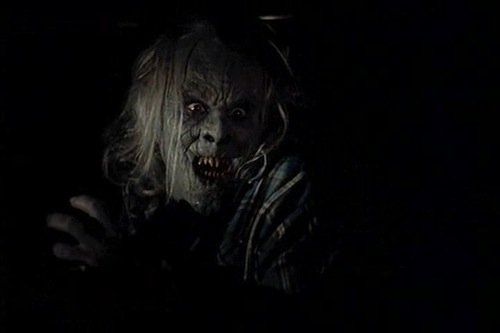
When Buddy 1 goes full demonic, it is clear we've entered into the Twilight Zone.

The movie is comprised of four segments, along with the aforementioned prologue and an epilogue, directed by John Landis, Steven Spielberg, Joe Dante, and George Miller respectively.  

The first two segments are weak in comparison to the crescendo that builds once Joe Dante's segment begins.  

"Time Out" by Landis takes a modern racist and sexist who beliefs are finally compromised and submerges him into another dimension where he is victim of prejudiced thought.  He journeys through Nazi Germany, a KKK ruled South, and American-occupied Vietnam.  The protagonist's patriotic rage critiques American inconsistencies.  Landis's segment is so weighted with political allegory that it forgets to establish the eery tone synonymous with the Twilight Zone series.  

While "Time Out" lost sight of its genre intent, "Kick the Can" by Steven Spielberg appears to have lost the memo completely.  It's classic Spielberg, where sentiment drenches our eyes and ears and hearts.  The score soars as two favourite devices of nostalgia are manipulated for the love of film.  Juxtaposed here are childhood innocence and old-age loneliness.  Children and the elderly are exploited for their seemingly fragile sensibilities.  It takes the poignant blueprint of Peter Pan and rams it off a wall until it is deranged.  It is whimsical and cute but trite in comparison to the fantastical and horror potential that the subsequent segments offer, and inadequate for the Twilight Zone oeuvre. 
Creepy Damien surrogate in "It's a Good Life."


It is a relief to leave the Spielberg hallmark moment behind.  Joe Dante's  "It's a Good Life."  Like "Time Out," it resembles a work of social commentary, in an world eschew where a young boy seems to rule proceedings. Cartoons, where there is a promise that anything can happen, form a motif.  The combination of cartoon imagery and sinister plot make for a macabre experience.  This is Burtonesque before Tim Burton really was.


See.  Burtonesque.
The grand old adage of saving the best for last has never been more accurate.  John Lithgow spiraling into a psychotic panic in George Miller's "Nightmare at 30,00 feet" is what cinema was made for.  Add to that a cramped airplane, a storm, and some goblin of sorts and people, we have a movie!  The epilogue that quickly follows is the perfect bookend to the piece, and redeems the movie.  


Lithgow.


It's been described as horror, and while there are horror elements used, this is more of a warped fairytale.  Drama that exams the distortion of mind and society rather than the disintegration of relationships.  


Sunday, November 20, 2011

Frightful Film Nights

Upon seeing Fright Night, the 2011 remake, this past September, I read numerous reviews basically stating that 2011 could not hold a candle to the original.  As a film enthusiast, I will not claim to be a film geek as their is much still much to learn and see, I decided my own investigation would need to be done.

Usually, I would agree with the assertion made by Total Film's Rosie Fletcher that not only do we not need another vampire film (blame the woeful Twilight and its overexposure for ruining it for everyone else) but remakes of classic are pretty much unnecessary anyway.  A classic deserves not to be tarnished by the presence of a film that resembles the desperation of a sorry Gaga-ite on all-Hallow's Eve.

Craig Gillespie's 2011 film takes a more measured approach, and refrains from delving straight into the action as Tom Holland did.  This was not a downfall on Holland's part, as the writer he created a blend of suspense horror with a self-aware comedic undertone.  For instance, Peter Vincent questions the formulaic exposition of horror, and the superficial whim of the genre and audiences at that, "Apparently your generation doesn't want to see vampire killers anymore, nor vampires either.  All they want is to see slashers running around in ski masks, hacking up young virgins."

Evil Ed meanwhile finds delight and solitude with Jerry's promise of peace in the supernatural, while Charley's quest to find out the truth about Jerry is punctuated intelligibly with cinematic horror images.  How very Blade Runner of them.

The Rear Window and Nosferatu references made me squeal with delight.

This kind of blatant, sarcastic pastiche was missing from Fright Night 2011.  Though the narrative itself was arranged in a more cohesive manner, the self-aware dimension and horror influenced made the characters seemed tired and bored rather than the ironic ease and mischievous as their 80s counterparts.

McLovin, I mean, Christopher Mintz-Plasse and Colin Farrell had the most fun Fright Night 2011.  Far from the suggestion that Farrell could not muster the ability to truly intimidate, Farrell's Jerry embraced a far darker character than Chris Sarandon managed to establish.  Jerry a la 2011 is far more calculating, and let's be honest subtle.  Sarandon, next time you help yourself to a bite of naked prostitute, try closing the curtains.  Respect your neighbours.  Especially the horny teenager next door.

Jerry in 2011 is flirtatious, but a man on a mission, without giving away too much, this Jerry has a major evil plan, a character arc all of his own, which lends a dimension lost in Sarandon's suave Yuppie Jerry.

2011, while overall a film of quality entertainment, suffers in the same way that many modern films do, its over-reliance on both modern technology and techniques. The overt product placement, such as when teen Charley uses a handy iPhone app to get tips on how to pick a lock, and the of course the CGI that overwhelms.  Though this movie is no Transformers.  Our eyes are not assaulted with a deluge of stark images.  However the Jerry of 1985 is more impressive in a creative sense, the transformation into full-blown creature of the night is so visceral it is that much more believable.  Jerry of 2011 looks like a deranged Hulk.


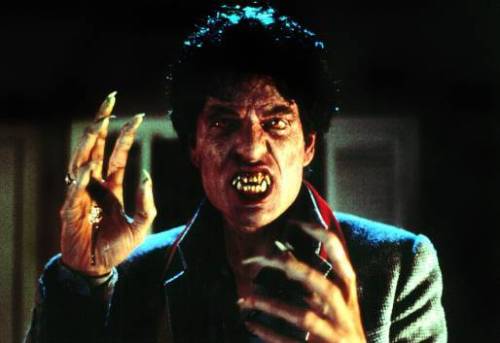
Sarandon:


Farrell:


Fright Night, both films, are now firmly planted among my favourite of the vampire genre.  For their postmodern awareness of the milieu alone they control the narrative as no other has since Nosferatu, the original and the brilliant.  So go, go have yourself a Frightful Night.


Monday, May 16, 2011

Sunday Viewing

When you're feeling bored.  And don't feel like research.  What ya gonna watch?  
Ghostbusters!

Another hazy, lazy Sunday.

This week, Ghostbusters!


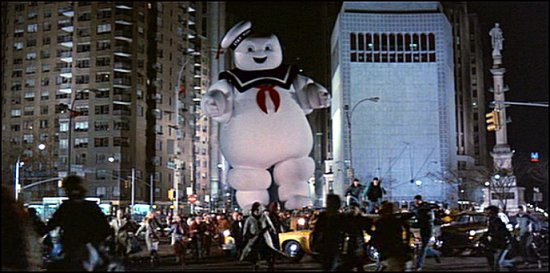
Stay Puft Marshmallow Man - greatest screen villain of all time.  Also the pinnacle of the amount of product placement in this film.  The 80s is when it all really started, and when there was very little subtlety.


Also while doing a little Youtube surfing I came across the following.  Premake trailers are basically a re-imagining of a film as if it were made in another era.  Their UP trailer is spectacular.  Here is the channel, but for now here is their take on Ghostbusters.  The collection of 50s clips used inspires an uncanny resemblance to the original, and echoes that hysteria that existed in that period of horror film.  


Aaaand.... Bill Murray.  Legend.


Your Mom Goes to College

The title is a homage to what I have recently titled my favourite movie, Napoleon Dynamite.  I remain positive that it is not my ultimate favourite, for as any film fan would know, that accolade is impossible to bestow.  I am rather fond of it, though, and could watch it repeatedly and still laugh when kip goes "yo mamma" on Deb's ass. 

Enjoy. 


Saturday, May 14, 2011

The Amazing Parody

I'm obsessed with all things Wes Anderson recently.  This has possibly been inspired by watching Bored to Death, starring none other Max Fischer himself.  I have already professed my love for The Royal Tenenbaums and what I think is cinema's greatest opening credits.

With great art, comes great parody and because Anderson belongs to the auteur set, his work inspires immense spoofing.  I came across this treasure on one of those Icanhascheezburger sites.  Hey, I am a student, how else am I to procrastinate for hours at a time.

The following video is what a Spiderman film would look like it brought to you by Wes Anderson, and presumably Owen Wilson for that matter.

Though satire is inherent, it reeks of pastiche that suggests the ultimate homage.  It presents a pace and style that complements Anderson's along with even precisely reproducing the movements of his camera.

Prussian Sunsets, I tip my hat to you.

Thursday, May 12, 2011

Mad Men-centricism

Yeah my research has me thinking about all things Mad Men about 67.5% of the day.  That exact percentage.  You can review the numbers if you want.

So ANYWAY today's reading has brought me through a lot of advertising history that is referenced in the show, specifically today, cigarette advertising.

So in the Pilot episode of the series, Smoke Gets in Your Eyes, Sterling Cooper are faced with a mammoth task of redesigning the way cigarettes are promoted, as their client Lucky Strike are feeling the pressure after the emergence that smoking is harmful to one's health.  Imagine that.  (Oh, 1960, you!)

One of the most interesting aspects of the episode comes when Don Draper is left speechless in the pitch to Lucky Strike and Pete, a junior executive, steps in with a play on the psychological research noting Freud death wish analysis that Don had refuted hours previously.

This death wish has been considered by critics to refer to the Marlboro Man campaign championed by Leo Burnett.  In short it epitomized masculinity of that era.  It incorporates notions of America's New Frontier along with suggesting a nostalgia for "when men were men", the virility of the cowboy.

The death wish hypothesis is in fact perfect for the marketing of cigarettes, especially in light of the (then) newly developed research.

     "The death wish is fundamental Freud.  He posited that men and women harbored a counterintuitive drive
      toward self-destruction to counterbalance our will to live."
                  Natasha Vargas-Cooper.  Mad Men Unbuttoned:  A Romp Through 1960s America.

I took to Google for a quick image search so I could see the campaign myself.  Here I leave you with, the Evolution of the Marlboro Man.  There is a defiant John Wayne and Eastwood thing going on.