Showing posts with label Culture. Show all posts

Wednesday, June 13, 2012

I'm Shakin'


Jack White for Interview Magazine, May 2012

Shopping the Music Stash #2 - Oh Land

Another album eponymous of the artist, this could very well become a trend in this loge.


Danish songstress Nanna Oland Fabricius, stage name Oh Land, is another of my NYON-inspired musical finds.  She further epitomises hipster cool and fails to buck trends as she has since relocated to Brooklyn since her first album Fauna back in '08.  (As of yet I have still failed to get my hands on her debut).  Oh Land's like-named 2011 album does however serve to sound a million miles away from the Williamsburg oeuvre that clouded the music scene in recent years.


If I were to describe Oh Land's sound generically, then it would be a contemporary fusion of pop and electronica, Bjork's baby perhaps.  But this is my blog, my territory, so from henceforth, I decree that Oh Land is the Queen of celestial pop.

Close your eyes when listening to her sophomore effort, you'll feel like you been transported to a outer space cavern looking down upon earth, doing cartwheels of inexplicable glee, free from the anxiety-ridden gravity of this world.

Now, if anything, Oh Land's style has been cultivated through the school of Arcade Fire and Polyphonic Spree thought.  Multi-instrumental pieces, containing everything but the kitchen sink, but in the hands of the right minds and producers, the finished product is cohesive with beautifully distinct elements, like a patchwork quilt.

All at once introspective and uplifting, Oh Land's lyrics weave a philosophical and endearingly defiant tapestry when combined with the percussion-dominated melodies.

It sounds ghastly redundant, but when listening to Oh Land's music, you sense twinkling.  I feel so twee after stating that.... So to reassert my academic credentials, it is an otherworldly experience, and due to her pseudonym, Oh Land is obviously greatly conscience of her second self and in contradictory possession of her Other.  Jane Eyre, she is not.

She owns, and cultivates the fiction surrounding her.  She tells Interview that she has created what she feels is an epic poem, something that is not hard to agree with when she gives a glimpse of the environment she grew up in.

“We had turtles and rabbits and cats and guinea pigs and birds and chickens,” she continues, describing the fable-like environment of her childhood. “We had sewing machines and instruments and there were always the craziest people coming in and out because my mom was teaching opera or my dad was rehearsing with some musicians or my sister was making clothes.”  Source - Interview Magazine

It's little wonder her music excels in eclecticism and celestial manifestations.

I shall not litter the post with song suggestions, but this, Turn It Up, was one of my anthems from last summer, essential, I believe, to all playlists.  Enjoy.

She's a more refined Lady Gaga, this is music you will not tire of, you are welcome.  

*Disclaimer -  I admire Lady Gaga, even listen to some of her music, but it gets tedious let's be honest.


Tuesday, May 1, 2012

Mirror Mirror

I wanted to love this movie.  So bad.  It could be my distaste for Kirsten Stewart's acting range that motivated me, but I wanted to adore this film.

Mirror, Mirror as you may, most likely, already know is a retelling of a the Snow White fable, with a few new innovative adjustments to the story.  The reference to Stewart of course refers to the second Snow White film which is to follow later this year, while Stewart's takes on a darker, brooding concept, Mirror Mirror bathes in a mash-up of romance, comedy, and caper.  This will be one of its downfalls, it doesn't know what it wants to be.


There were many elements going for it, the costume and set design is spectacular, fantastical, and whimsical, everything you would crave from a fairytale.  The dresses of the two leads, The Queen and Snow White were particularly impressive, each costume change expressing their character and providing a indicative motif for the viewer.  The Queen was ostentatious, Snow White was innocent, decent, and fair.

It was refreshingly tongue-in-cheek.  The sarcastic pinging gleam of teeth punctuates the smaltz so as to prevent the audience from lapsing into a sugar coma.

The few narrative additions were surely an attempt to give the Snow White tale relatability for those who aren't fans of princess-romances.  The seven dwarves were given motivation in life beyond their lust of Snow White; Prince Charming was given a personality; and to make The Queen really wicked beyond her hatred and neglect of her step-daughter, the film made sure to show the poverty-stricken subjects of the kingdom, whose only hope is, you guessed it, Snow White.

All the elements are there for a successful and enjoyable film, but Mirror, Mirror has spun itself a web too big. It fails to control all these subplots and bring them together as a cohesive entity.

It's disappointing, particularly when the opening is deliciously good.  The Queen is narrating over a brief animated summary of the last sixteen years, and we are led to believe this is going to be her story.  This is a ploy to lure you in to a false sense of intrigue.  Because the apparent focus on Julia Roberts's fantastically wicked Queen bitch is soon overshadowed by Lily Collins's pathetic protagonist.  Talk about casting actresses with no emotional dimension as Snow White.  Sure she looks the part, but it was if she just copied the Snow White from the original Disney animation.  She lacked the endearing passion that is so intrinsic to carrying a film.

Unfortunately for me, this cinema outing lacked the promised fairytale quality.  Had the story stuck with the Queen it may have been saved.

Thursday, February 9, 2012

Murder She Will Write


My sister asked me to find mom's old typewriter and all I could think about was this.


Spaced

The soundtrack in Spaced makes me feel spaced.


ahhhh  *edit

forgot about THAT


(#REWATCHING SPACED)

The Descendants

Although it would be nice for the Academy to get over their George Clooney-love in, The Descendants trailer was undeniably appealing.  It looked invigorating, spiritual, a perfect anecdote to the gloomy shroud that consumes you during winter.

(Will not be held accountable to adverse affects experienced from lusting after Hawaiin climate...)

The film marks also the return of Alexander Payne, last heard from with Sideways.

The film opens with a brief shot of a woman on what appears to be a jet ski, what is compelling about this scene is her expression, one marked be utter contentment.  The fade to black is ominous.  We soon learn that that woman was Elizabeth King, now in a coma, a wife to successful and frugal lawyer Matt King, who is diligently working by her hospital bed in the establishing shot where he narratives a brief summary of life and up to there.


The coma acts as a catalyst which through Matt's otherwise comfortably uneventful life is thrown into disarray where he must acknowledge things and take action.  He is forced to commit to parenting for the first time in his life, referring to himself as the back-up parent.  His unruly seventeen year old Alexandra, played by the unexpectedly sublime Shailene Woodley, and petulant Scottie are independent forces to be reckoned with.

He learns his wife was cheating on him and planning to leave him.  While this sets things in motion for the journey of the film, the trailer makes it seem like this is what the film centers on.  Wrong.

Matt's entire journey seems to be summed up in the allegory of the land.  He is the named trustee to a large acreage of land, and he and his cousins are in the process of figuring out who to sell the land to.

Because the subplot of land, (woah careful now, I am making this sound like a sequel to The Field) Hawaii predictably becomes a character in and of itself in the film.  It clearly has a profound effect in rebuilding the relationship between Matt and his daughters, and helping them through their grief and anger experienced in the aftermath of their mother's accident.

This would be my only gripe about the film.  Its predictability.  It does not shy away from cliche or sentiment, which is probably a result of the source material, the novel by Kaui Hart Hemmings.  While it is far from a run of the mill chick flick, there is almost a paint-by-numbers characters progression but this has thankfully been peppered with enough Alexander Payne flair to rescue it and brings it to life.

It's a genuinely funny piece.  It combines many levels of humour without going overboard, we get a little bit of physical comedy, thanks to out of shape Matt's jog in flip flops down a spiraling Hawaiian suburban hill.  There's a little bit of stoner exploitation, courtesy of Sid, (Nick Krausse), Alexandra's inexplicably present boyfriend.  The caper quality, perhaps a nod to Clooney's Ocean Series, bestows the film with an adventurousness that involves the audience, giving a emotional connection.  You will root for this family as they scour the beaches in search of the adulterous mother's partner.  Also the Hawaiian uniform provides a good ole laugh, probably unintentional.


Clooney is obviously promoted as the face of the movie as he's a big box office draw, but the way each character is drawn in this story is genius.  Each character is given such dimension.  Even Brian Speer (Matthew Lillard), the man whom Matt's wife was in love with, is likable because his vulnerability is shown.  So even though the movie itself delves into cliche, the characterizations and actual performances strengthen any weaknesses.

Even though I was hyper aware of the cliche, blame my English course in film for making me so judgmental,  the film still manipulated an emotional response out of me.  Because what is shown in The Descendants is truth in many ways.  It does not dwell on the "why me"s, but simply shows these people dealing with everyday life even though their world has utterly changed.

Cliche is cliche for a reason, even though we think we are all individual, we all invariably go through similar experiences of pain, beauty, happiness, and grief.  The Descendants is actually a very refreshing take on that, not unearthing shattering, but thank Hawaii.  And Alexander Payne.


Wednesday, February 8, 2012

Shopping the Film Stash #3 - Frankenstein (1994)


So how grossed out were you when Frankenstein was covered in amniotic fluid?

Overall I think this film was unintentionally hilarious.

Good day!

Monday, February 6, 2012

The Ignored

While the Oscars, in the long run, do and should not affect the quality of a film, the awards show and a nomination sure as hell invigorates the life of the film and actors and manipulates the public's own perception of a film.

Let us take George Clooney for instance.  Who really took him seriously before he won for Syrianna and was nominated for Good Night, and Good Luck?  He was ER star who transitioned fairly seamlessly to film, but was primarily known for his roles as a playboy-esque, cheeky chappy.  He started working with the right people however, the Cohen Brothers, Steven Soderbergh... and has since possessed a glistening Academy Award sheen.  He can literally do no wrong, and even though as an actor he is flat and little bit of a one trick pony in terms of depth of character, he has for the last few years pretty much been a permanent fixture throughout awards season.

Sure he doesn't really deserve to be there, but is there, and is being acknowledged, like so many other "meh" performances.  Not that are really and truly meh, and not that I really have a problem with Clooney, but Awards season has become achingly predictable.  Every show basically has the same list of nominations.

(On a side note, who would have thought such a mediocre novel such as The Help would have inspired such a passionate response for its filmic version?  Either that or voters are afraid it would have been prejudice not to include it.)

While my distance from a cinema has sadly hindered my access to most of the nominated lot this year, there are a few glaring omissions that I would love to briefly discuss.


Melancholia
more in-depth review here


Maybe I am alone here, after all it received only average ratings, from the likes of Total Film and Empire, from what I can tell, but I felt Melancholia was the "revelation" moment of cinema in 2011.  In a society so bruised by economic strain, a possible impending apocalypse, and in a planet where depression is still discussed in hushed voices, Melancholia was unafraid to tackle the everyday strain of existence and expand it into a feature length masterpiece.

Lars von Trier has more than likely been permanently shunned by Hollywood after his bizarre Nazi comments in Cannes, but what a shame that the film and actors anchoring the project have been ignored also.

Kirsten Dunst and Charlotte Gainsbourg achieve something so very rare in film, they deliver muted suffering that speaks volumes more than hysteria.  There are intricacies of gesture, expression, and hesitation that is magnified by hand-held camera motion.

Performances such as these always impress me more than a portrayal of a real-life character. Not that Meryl Streep's performance as Margaret Thatcher wasn't amazing and powerful, it was.  But to bring to life a character so vividly from its foundations in the two-dimensional space of screenplay is something really worth speaking of.


Super 8


Yes it was a summer blockbuster.  Yes it was sentimental.  And YES it was a Spielberg pastiche if ever I saw one, but those are also the reasons I adored this film!  I can guarantee it will just bring you right back to when you were a kid, when you first started watching films, and were in awe of the very medium you were witnessing.  It is the Cinema Paradiso for the 21st century.  And yes, I am aware that was released merely twenty odd years ago....

The storyline was a little cliche, but a lot of films are cliched.  Super 8 just reawakened the soul!  I can barely describe this probably I just simply urge you to see this.  It gave children a voice beyond the wacky, cheeky, snide cartoonish renderings we have been seeing in the past decade and it was showed the parents and children can be vulnerable as well as brave.

It was the perfect anecdote to the summer/thesis blues.  I have not seen Hugo, so I guess I am being completely bias, but Hugo looks so extravagant, I am all for the blue collar underdog which is what you will find with JJ Abrahams pet project.  And Hugo was 3D. Eugh.

Where is the best original screenplay?  And WHERE is Elle Fanning's recognition?


The Guard

Maybe this movie didn't travel well.  It is extremely colloquial, and to weaker disposition, probably offensive.  Besides comedies rarely capture the Academy's attention as well as a good weepy.

But wait.  Melissa McCarthy, nominated.  Maybe there will be hope for Brendan!  Nooo.

Yeah I have a love hate relationship with Bridesmaids.  It was funny, sure.  I laughed, yes.  Those girls were funny, yes.  But I would not return to this film.  There's nothing there beyond a single viewing.  The only revolutionary thing about it is that is starred and was written by women.  Women writers have been around a long while and have been doing just fine for themselves.

The comedy was gross out comedy with girls.  Not terribly engaging, sorry to have to say.  It was funny in a kneejerk, slapstick kind of way but on repeated watch the lustre will fade.  McCarthy was brilliant because it was a unabashed physical and comedic performance, but it was like her antics was carrying the film.


Gleeson, on the other hand.

I know they say Ireland, the Irish, carries a beautiful duality of humour and melancholy and this is what Gerry encapsulates.  Just when you think he is one dimensional thuggish cop, you see him with his mother.  He is humanised.  He has woes, and faults, and he is real.

50/50

Yeah I've spoken about this before too so I promise I really won't bore you with this one, but let us just say it has been robbed everywhere by all accounts.  Bryce Dallas Howard for being a heartless bitch in the face of cancer.  Seth Rogen for being the obnoxious but lovable and caring friend.  Joseph Gordan Levitt, for enlivening a character who is suffering but who refuses to go down the route of caricature, where the bucket lists reside.  It is relatable, and endearing, and Angelica Huston remains a force to be reckoned with.

We Need to Talk About Kevin

Terrifying and challenging to watch. Yet refreshing to see a portrayal of a mother who find it hard to unearth the patience to rear or even love her son.  She's a woman tormented by unfulfilled aspirations, and barely hides the fact that she blames her son for her stilted life.  Then there is Kevin.  Damien incarnate.  Not so much evil as seeking his mother's love.  A film calling attention to the fact that we are all products of our environment.

Tilda Swinton and Ezra Miller have suffered a grave injustice.


------------------


I literally think my favourite thing about film in 2011 is when filmmakers and actors just went for a more pared down version of a film character, and situated you in a more realistic space and life.  Relatability is a very attractive thing in cinema.  Don't forget this Film of 2012.


Sunday, February 5, 2012

Currently Reading...


So far, a tough read, Lou's inner voice is very convoluted.  You feel like an accessory to the crime just by being privy to his thoughts. 

Shopping the Film Stash #1 - Heathers

As I now live two hours from a decent cinema that offers variety and limited release choices, I have been both gathering and diving into the DVD archives.  I have found myself creating a list as long as my harm, a bucket list of films to see, to study, to learn.  Directors, script-writers, and actors constantly site various source material when speaking of their craft, and throughout the last year while writing my thesis and pouring over various film reviews I have learnt that a film critic is no different.  The annals of film is a critic's bible when writing an objective review.

So to train my amateur writing hand a little better I am setting out on a little exercise and visiting some cult classics, films that have come to my attention over the last year but have so far been somehow neglected, and perhaps even some oldies that I love!

All in the hopes of extending my film vocabulary....


Heathers (1989)

I remember seeing Mean Girls in the cinema thinking it was refreshingly different from the other teen comedies that had been circulating around that era (the era I speak of is that Golden Age of Millenia-teen films, 10 Things I Hate About You, Down To You, She's All That, but to name a few, I guess Mean Girls was a few years after, but you get my drift).  Mean Girls came along and set about debunking the romantic notions of teenage-hood, and decided to shed some light on the harsh realities of High School.  There was less, I stress less, of a focus on the girl-likes-boy dilemma while the examination of the fickle foundations of female friendships really takes center stage.

Though Tina Fey's originality and wit are boundless, Mean Girls, its plot, and characters owe everything to Heathers.  Heathers is a far superior, satirical, more sinister commentary on the tenuous years of High School.  It villainises these characters, giving them unprecedented power, the exaggerated (but not altogether unimaginable) murder plot parodying the usual hormonal deviations of an American teen.

"I just killed my best friend"
"And your worst enemy"
"Same difference"

Well hello, shoulder pads...

Veronica, the oft under-appreciated Winona Ryder, is a girl who is not named Heather but who has been given divine access to the elite Heathers clique, for reasons unknown.  At first she feels privileged to be included and is even enthralled by the warped superiority of the malevolent lead Heather.  She is enamoured by Heather's philosophies, that in fact justify her tyrannical ways, "Dear Diary, Heather told me she teaches people real life."  The film is full of gems like this, Fey wishes she could be this raunchy and self-assured in her writing.  Heather 1 is like a cacophony  of teenage-hood and adulthood, she is self-possessed, relishing her youth yet outgrown the anxieties of her peers.  She is acutely aware of her surroundings, so much so that she has created her own glossary, according to her authority, "very" marks a seal of coveted approval, Heather desires very, because she desires excess and vitality.

She blithely critiques the stereotypes of youth, and condemns her followers for falling victim, "Grow up Heather, bulimia is so '87."  Still inevitably lacking sympathy, Heather's independence is what makes her both enviable and caustic.

She eventually tethers nerves, leading Veronica to naively succumbs to her new boyfriend's scheme to throttle the queen bitches, after unwittingly becoming an accessory in Jason's murder plot, when Heather 1 ingests her poisonous end.

Christian Slater plays Jason Dean, and though in Jack Nicholson's psychosis The Shining mode, when clothed in leather jacket and straddling a motorbike he personifies James Dean 2.0.  He is an 80s incarnation, the upper-class rebel without a cause who sets about invigorating a spirit into an era that lacked the rebellious attitude that drenched the Hippie 60s and 70s punks.

Slater, making evil acceptable in 1989.
Though murder and mayhem landmark her journey, Veronica is actually an admirable character, even somewhat a feminine role model.  She takes a stand, an intense one, against bullying.  And though they are the MTV generation's Bonnie and Clyde, when she realises that she has descended into psychotic territory with her boyfriend she transcends this too.  She evolves beyond the suburbia complex, the vacuous pandering of unmitigated angst.  Even this is tackled ironically, when after further rampage, Veronica consults her diary again, professing that "...my teen angst bullshit has a bodycount."

Veronica's rebellion from standards is where it is actually a reverse of Mean Girls.  Mean Girls begins with Cady and her friends devising a plan to conquer and destroy the influence of The Plastics.  Cady herself is blinded by power leading to a somewhat smaltzy ending where everyone learns their lesson and lives happily ever after.  Heathers' resolution, if it can be called that, is far more cathartic.  It abandons sentiment, a pitfall that much mainstream American cinema.  Both film's exhibit climatic scenes in a school gym, both are executed extremely differently.  Mean Girls looks like an after-school special in the shadow of Heathers' explosive metaphors.

The final word on Heathers.  How very. 

Monday, December 12, 2011

The Majesty of Melancholia


When the opening sequence of a film is reminiscent of a series of Surrealist painting you know you are set for both a aesthetically and intellectually challenging ride.


"I'm trudging through this grey wholly yarn.  It's clinging to my legs.  It's really heavy to drag along."


These days Lars von Trier is more infamous for his strange Nazi outburst at Cannes this past summer, which is a shame because that has overshadowed what he has achieved with Melancholia and will inevitably damage the film's chances at future award ceremonies, though it is one of the cinematic stand-outs of the year.

Both visually and thematically, von Trier re-imagines the genre of the apocolyptic film.  The all consuming nature of depression has been given the an allegory as a new planet dubbed Melancholia that is veering towards the earth, threatening existence.  Compared to previous work, von Trier describes Melancholia as the moment when a deer wanders in to listen to Jiminy Cricket at the end of a Disney Christmas special. It is just about as comforting as the cruel manner in which Disney films lure you into a false sense of security only to then reveal a horrible reality.  Melancholia deals with the horror of existence and fear of non-existence.

Part One focuses on the perspective of Justine (Kirsten Dunst) and sees her public facade crumble on the night of her wedding.  Those around her personify the underlined tension, which magnifies each time Justine disappears from the party.

We not only experience Justine's disintegration due to the overwhelming gravitas of the wedding reception organised by her sister Claire (Charlotte Gainsbourg) and her "filthy-rich" husband John (Kiefer Sutherland), but also the effect that Justine's illness and erratic manner have on the various members of her family.  Her guileless husband (Alexander Skarsgard), her oblivious father (the exquisite John Hurt), and a mother (Charlotte Rampling) who has no filter.

The film becomes disconcerting because at first Justine has a vivacious energy, then comes her mental descent, as the stifling ritual of the wedding etches away at her vulnerable psyche.  Though Claire sees Justine's behaviour as disrespectful, there is a sense that Justine is desperately trying to fight and repair herself before the evening is ruined.  When she goes AWOL to take a bath, this is a healing action, an effort to cleanse away what is perceived as mental impurities.

Melancholia will be appreciated because of its refusal to depict unnecessary hysterics to communicate Justine's experience.  The indeterminacy her mentality in contained in an authentic and relatable mode of communication.


Throughout Part One, though an underlying resentment does emerge between Justine and Claire, yet Claire still remains loyal to her sister through her suffering.  In Part Two this theme is extended, though in reverse perspective.

We witness Claire battles her own neuroses, and the threat of Melancholia's ever-nearing presence reassigns the position of the sisters.  Justine is acquiescent and calm of impending events while Claire is frantic.  Call it her maternal instinct in wishing to protect her son, but Claire is unable to accept the forthcoming doom.  Her pragmatism unravels in the face of looming threat.

Dunst and Gainsbourg achieve a great symbiosis on screen.  They flesh out these sisters, their relationship and history, meanwhile never detracting focus from one another.  


Those familiar with Trier's older work, and Dogme '95 will see glints of the original guidelines within Melancholia's makeup. The manifesto included rules that emphasis the use of handheld camera, the work to be filmed in colour, and no superficial action (aka murder).  While the aforementioned aspects are noticeable here, von Trier has largely abandoned the restricting methods of Dogme.  

 The most impressive element of Melancholia is that it is able to maintain engaging momentum throughout its meditative exposition.  As surreal and disjointed as proceedings are, the emotion is relatable as it never veers in to the overblown territory that Hollywood would have taken it. 


Saturday, November 26, 2011

The Big C on the Big Screen

Saw 50/50 in a matinee screening (why did I fail throughout my college years to attend these precious five euro matinee screenings?) earlier this week.


This is the first film in quite a while to deal with the implications of cancer so candidly.  Cancer's devastating potential is given more potent arsenal here when 27-year-old Adam (Joseph Gordan-Levitt) is diagnosed with a rare form of cancer affecting the spine.  The story follows him as he deals with treatment, an indifferent girlfriend (Bryce Dallas Howard), a boisterous friend, Kyle (Seth Rogen), who sees the romance-scoring potential in Adam's recent trauma, a distraught mother (Anjelica Huston), a Doogie Howser-like psychologist (Anna Kendrick), along with the stoner friends he makes in chemotherapy (Matt Frewer and Philip Baker Hall).

50/50 finds its strength by not immediately relenting to the stagnant habit of illustrating tragedy in the aftermath of diagnosis.  There is no sense that Adam has received a death sentence.  The events that unfold are even somewhat mundane.  This is the reality, in the face of illness, a majority of people will not endeavour to fulfill grandiose adventures.  Bucket-list sentimentality has been abandoned, instead communication is the main focus.  The story arc of this tale focuses on Adam's struggle with contending with the upheaval of living with illness.

I was expecting Rogen to contribute nothing more than a comic relief to the decidedly depressing material, yet he supplied a surprisingly nuanced performance, and the chemistry between himself and Gordan-Levitt genuinely captured the tension that infiltrates even the most secure of friendships, when conflicts arise and yet remain unacknowledged.  Adam is mired with medical and personal woes while Kyle attempts to steam-roll through and offer uplifting alternatives for his buddy, neglecting Adam's escalating depression.  The old adage of ignorance being bliss can only carry so far, and tensions eventually come to the fore.

Despite my own focus on the heavier material in the film, it is not without its hilarious, poignant, lonely, apprehensive, and euphoric moments.  Those are a lot of adjectives I have just named, simply because 50/50 has that rare quality of contemporary cinema in offering a truly human perspective on events.  There is something for everyone.  You WILL relate to this.  It is mixed and fucked up because this is life.

My favourite moment reminded me of the joys and tribulations of family.  Kendrick's psychologist Katherine meets Kyle and Adam's parents.  Huston's Diane skims over awkward chit-chat, and defending herself states, "I want you to know I smother him because I love him."  By unleashing her bad-ass Mama-Bear, Diane proves what I think the film articulates so well - and that is that even in vulnerability there is strength and resilience.  Every character displays the colours of experience, emotion, and even regret.  And that is what in the end makes it such a resonating work.


Monday, November 21, 2011

Ceremonials


Song - Breaking Dawn

Not unusual
Been listening to Florence's new album on repeat this week
Not only is the music stunning, ephemeral, and haunting
But the album art is gorgeous, it harks to the period of Art Deco but becomes timeless almost because of Florence Pre-Raphaellite beauty.


Sunday, November 20, 2011

Frightful Film Nights

Upon seeing Fright Night, the 2011 remake, this past September, I read numerous reviews basically stating that 2011 could not hold a candle to the original.  As a film enthusiast, I will not claim to be a film geek as their is much still much to learn and see, I decided my own investigation would need to be done.

Usually, I would agree with the assertion made by Total Film's Rosie Fletcher that not only do we not need another vampire film (blame the woeful Twilight and its overexposure for ruining it for everyone else) but remakes of classic are pretty much unnecessary anyway.  A classic deserves not to be tarnished by the presence of a film that resembles the desperation of a sorry Gaga-ite on all-Hallow's Eve.

Craig Gillespie's 2011 film takes a more measured approach, and refrains from delving straight into the action as Tom Holland did.  This was not a downfall on Holland's part, as the writer he created a blend of suspense horror with a self-aware comedic undertone.  For instance, Peter Vincent questions the formulaic exposition of horror, and the superficial whim of the genre and audiences at that, "Apparently your generation doesn't want to see vampire killers anymore, nor vampires either.  All they want is to see slashers running around in ski masks, hacking up young virgins."

Evil Ed meanwhile finds delight and solitude with Jerry's promise of peace in the supernatural, while Charley's quest to find out the truth about Jerry is punctuated intelligibly with cinematic horror images.  How very Blade Runner of them.

The Rear Window and Nosferatu references made me squeal with delight.

This kind of blatant, sarcastic pastiche was missing from Fright Night 2011.  Though the narrative itself was arranged in a more cohesive manner, the self-aware dimension and horror influenced made the characters seemed tired and bored rather than the ironic ease and mischievous as their 80s counterparts.

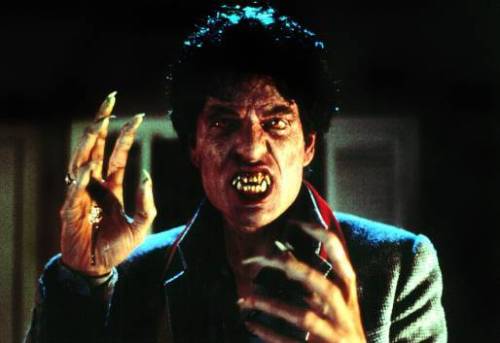
McLovin, I mean, Christopher Mintz-Plasse and Colin Farrell had the most fun Fright Night 2011.  Far from the suggestion that Farrell could not muster the ability to truly intimidate, Farrell's Jerry embraced a far darker character than Chris Sarandon managed to establish.  Jerry a la 2011 is far more calculating, and let's be honest subtle.  Sarandon, next time you help yourself to a bite of naked prostitute, try closing the curtains.  Respect your neighbours.  Especially the horny teenager next door.

Jerry in 2011 is flirtatious, but a man on a mission, without giving away too much, this Jerry has a major evil plan, a character arc all of his own, which lends a dimension lost in Sarandon's suave Yuppie Jerry.

2011, while overall a film of quality entertainment, suffers in the same way that many modern films do, its over-reliance on both modern technology and techniques. The overt product placement, such as when teen Charley uses a handy iPhone app to get tips on how to pick a lock, and the of course the CGI that overwhelms.  Though this movie is no Transformers.  Our eyes are not assaulted with a deluge of stark images.  However the Jerry of 1985 is more impressive in a creative sense, the transformation into full-blown creature of the night is so visceral it is that much more believable.  Jerry of 2011 looks like a deranged Hulk.


Sarandon:


Farrell:


Fright Night, both films, are now firmly planted among my favourite of the vampire genre.  For their postmodern awareness of the milieu alone they control the narrative as no other has since Nosferatu, the original and the brilliant.  So go, go have yourself a Frightful Night.