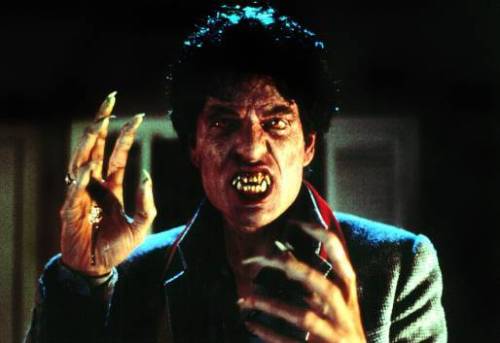
Upon seeing Fright Night, the 2011 remake, this past September, I read numerous reviews basically stating that 2011 could not hold a candle to the original. As a film enthusiast, I will not claim to be a film geek as their is much still much to learn and see, I decided my own investigation would need to be done.
Usually, I would agree with the assertion made by Total Film's Rosie Fletcher that not only do we not need another vampire film (blame the woeful Twilight and its overexposure for ruining it for everyone else) but remakes of classic are pretty much unnecessary anyway. A classic deserves not to be tarnished by the presence of a film that resembles the desperation of a sorry Gaga-ite on all-Hallow's Eve.
Craig Gillespie's 2011 film takes a more measured approach, and refrains from delving straight into the action as Tom Holland did. This was not a downfall on Holland's part, as the writer he created a blend of suspense horror with a self-aware comedic undertone. For instance, Peter Vincent questions the formulaic exposition of horror, and the superficial whim of the genre and audiences at that, "Apparently your generation doesn't want to see vampire killers anymore, nor vampires either. All they want is to see slashers running around in ski masks, hacking up young virgins."
Evil Ed meanwhile finds delight and solitude with Jerry's promise of peace in the supernatural, while Charley's quest to find out the truth about Jerry is punctuated intelligibly with cinematic horror images. How very Blade Runner of them.
The Rear Window and Nosferatu references made me squeal with delight.
This kind of blatant, sarcastic pastiche was missing from Fright Night 2011. Though the narrative itself was arranged in a more cohesive manner, the self-aware dimension and horror influenced made the characters seemed tired and bored rather than the ironic ease and mischievous as their 80s counterparts.
McLovin, I mean, Christopher Mintz-Plasse and Colin Farrell had the most fun Fright Night 2011. Far from the suggestion that Farrell could not muster the ability to truly intimidate, Farrell's Jerry embraced a far darker character than Chris Sarandon managed to establish. Jerry a la 2011 is far more calculating, and let's be honest subtle. Sarandon, next time you help yourself to a bite of naked prostitute, try closing the curtains. Respect your neighbours. Especially the horny teenager next door.
Jerry in 2011 is flirtatious, but a man on a mission, without giving away too much, this Jerry has a major evil plan, a character arc all of his own, which lends a dimension lost in Sarandon's suave Yuppie Jerry.
2011, while overall a film of quality entertainment, suffers in the same way that many modern films do, its over-reliance on both modern technology and techniques. The overt product placement, such as when teen Charley uses a handy iPhone app to get tips on how to pick a lock, and the of course the CGI that overwhelms. Though this movie is no Transformers. Our eyes are not assaulted with a deluge of stark images. However the Jerry of 1985 is more impressive in a creative sense, the transformation into full-blown creature of the night is so visceral it is that much more believable. Jerry of 2011 looks like a deranged Hulk.
Showing posts with label Vampire. Show all posts
Sunday, November 20, 2011
Saturday, January 15, 2011
Let the Right Film In
I took a European film class last year which was, shamefully, my first real education (academically, but more importantly, personally) on foreign films. Sure I have dabbled with some Japanese horrors, and with the odd foray into French phantasms, but the cinema I explored during those glorious few months transcended my expectations of what film, not simply narrative, could achieve.
Mmm, this is a little naive to have come from a third and, ahem, final year undergraduate, no? I admit it, I was ignorant. Which is daunting as I had previously regarded myself as something of a film buff.
However I have since committed to expanding my knowledge. So when I saw Let Me In had been released, I was not going to be tempted by the Americanized version, I sought Tomas Alfredson's Let the Right One In in its stead. Though I was skeptical. Vampire films are after all the genre du jour. If it is one thing more detestable than corrupt bankers and government officials, it is melancholic glittery vampires.
Let the Right One In tells the story of the complicated, burgeoning relationship between Oskar, a youngster tormented by bullying and emotionally torn by the separation of his parents, and Eli the mysterious vampire that moves in next door to Oskar. By depicting Oskar's experiences with his bullies in numerous cold environments, and his solitude in the abandoned, snow covered playground, Alfredson illustrates Oskar's isolation in the depths of the world. However, this alienation, mush like the one Eli suffers through in the attempt to keep her secret safe, is just that, a safety for them.
The intimate encounters, or as intimate as prepubescent teens can be, are the focus of the film. The moment in where Eli climbs naked into bed with Oskar is undoubtedly uncomfortable, but the innocence of their ages forces you to see beyond the sexual undertones. This moment clarifies the narrative intentions. The characters have transcended, by no longer seeking comfort in solitude, they seek one another.
The sparse nature of the film and its action is what I find so attractive about the Swedish films I have seen, (not many I will admit). They lack the urgency so prominent in the Hollywood formula, and that is a relief. The narrative economy leads to a more startling connection to the film and, like Hitchcock cinema of old, suspense itself is a character.
The vampirish elements takes a back-burner to the proceedings of the film, and when Eli's sufferings do come into the fray they are a lot more realistic. And bloody. There is no such nonsense as vegetarian vamps, or True Blood. When Eli is hungry Alfredson does not shy away from showing her pain and misery. Eli's vampire is shown not simply to be the mythical killer, but the victim too. She is a victim as she has been permanently been suspended in arrested development.
Victim-hood and its subsequent tragedies are Alfredson's primary reflection. In the final act he bestows a glorious redemption upon his protagonists. One that satisfies the true horror fans and the romantics.
Mmm, this is a little naive to have come from a third and, ahem, final year undergraduate, no? I admit it, I was ignorant. Which is daunting as I had previously regarded myself as something of a film buff.
However I have since committed to expanding my knowledge. So when I saw Let Me In had been released, I was not going to be tempted by the Americanized version, I sought Tomas Alfredson's Let the Right One In in its stead. Though I was skeptical. Vampire films are after all the genre du jour. If it is one thing more detestable than corrupt bankers and government officials, it is melancholic glittery vampires.
Let the Right One In tells the story of the complicated, burgeoning relationship between Oskar, a youngster tormented by bullying and emotionally torn by the separation of his parents, and Eli the mysterious vampire that moves in next door to Oskar. By depicting Oskar's experiences with his bullies in numerous cold environments, and his solitude in the abandoned, snow covered playground, Alfredson illustrates Oskar's isolation in the depths of the world. However, this alienation, mush like the one Eli suffers through in the attempt to keep her secret safe, is just that, a safety for them.
One of Oskar's many confrontations with his bullies.
The sparse nature of the film and its action is what I find so attractive about the Swedish films I have seen, (not many I will admit). They lack the urgency so prominent in the Hollywood formula, and that is a relief. The narrative economy leads to a more startling connection to the film and, like Hitchcock cinema of old, suspense itself is a character.
The vampirish elements takes a back-burner to the proceedings of the film, and when Eli's sufferings do come into the fray they are a lot more realistic. And bloody. There is no such nonsense as vegetarian vamps, or True Blood. When Eli is hungry Alfredson does not shy away from showing her pain and misery. Eli's vampire is shown not simply to be the mythical killer, but the victim too. She is a victim as she has been permanently been suspended in arrested development.
Victim-hood and its subsequent tragedies are Alfredson's primary reflection. In the final act he bestows a glorious redemption upon his protagonists. One that satisfies the true horror fans and the romantics.
Subscribe to:
Posts (Atom)